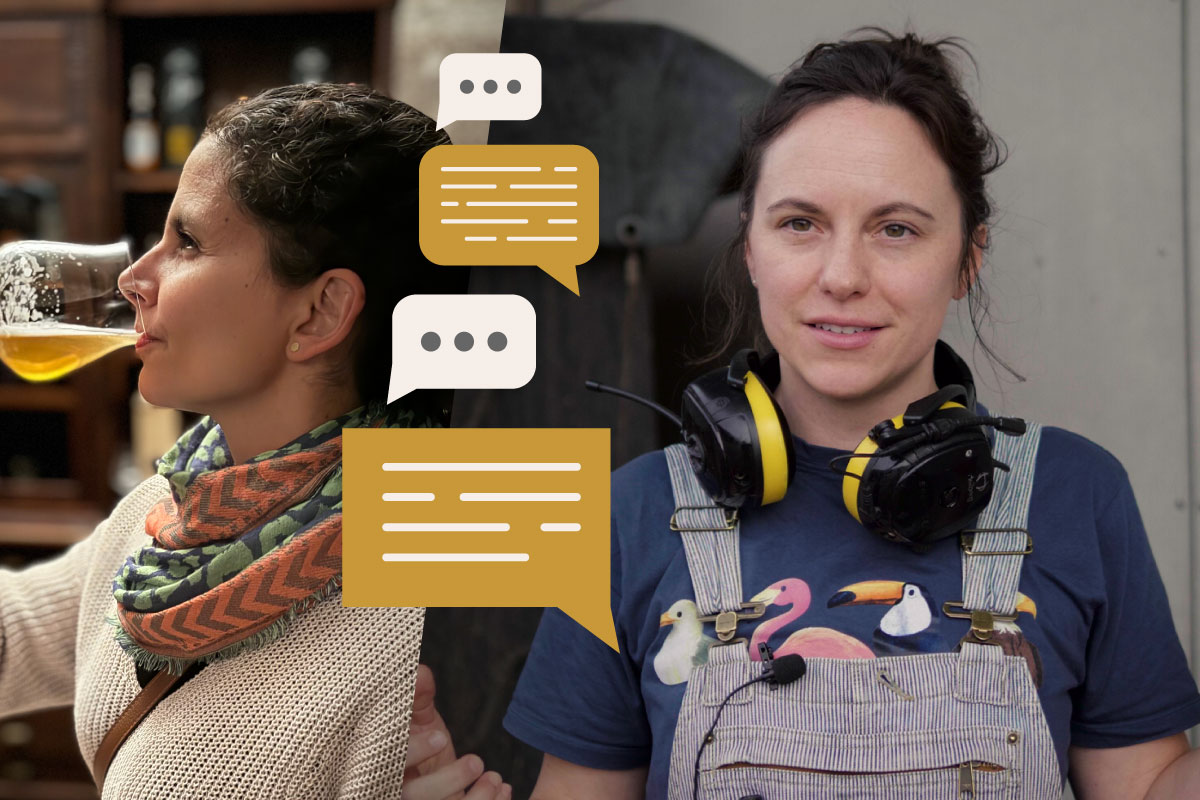
Beer sommelier Andrea Sarmiento interviews Erika Brockberg, quality manager at Stigbergets Bryggeri in Gothenburg, about curiosity, quality, the Swedish alcohol monopoly, AI-generated labels – and why Swedish beer could do with a broader range of styles.
Erika Brockberg has one of the more interesting backgrounds in Swedish craft beer. Originally from the United States, she has worked in various positions in craft breweries over the years, ranging from brewer to quality-focused roles. After working at Bell’s Brewery – one of the most respected names in American craft beer, with a long-standing reputation for quality – she wanted to move to Europe.
Eventually she chose Sweden, where she has worked with quality development at several breweries in Gothenburg. Today she is quality manager at Stigbergets Bryggeri, one of Sweden’s largest and most influential craft breweries, best known internationally for its hop-forward beers and modern IPAs.
The questions are asked by Swedish beer sommelier Andrea Sarmiento, who is currently training to become a brewer.
“A little bird told me that Erika may be one of the most highly educated beer experts we have in Sweden. When we visited Stigbergets in Gothenburg for a full day with the brewing program at Campus Nynäshamn, I was deeply impressed both by her knowledge and by her ability to explain complex things in a simple way. That is often when you can really tell that someone has fully mastered their field,” says Andrea Sarmiento.
Erika, how did you come to specialize in beer on such a deep level? And you are not allowed to answer that it’s simply because you appreciate beer as a drink!
“I kind of fell into beer as a career by accident. I inherited a love of good beer from my father, so I always enjoyed drinking it. I’ve also always loved science and math and focused on those subjects as a student. So when I started to learn more about beer and realized that brewing is essentially a practical application of microbiology, chemistry, algebra and more, I decided I wanted to study it further. And as with most scientific subjects, the more you learn, the more questions you have.”
“As I gained knowledge and experience in brewing, I kept wanting to look deeper and know more. For example, we might know that A causes B in the brewery. But I want to know why it happens, how we can prevent it or encourage it in the future, how quickly it happens, what the potential unintended consequences are, and what impact it has on the taste, aroma, body, shelf life, foam stability and so on of the final beer.”
“I guess that need for further understanding just never stopped. So, in simpler terms, my curiosity would be one answer. The other would be working with brilliant people in the industry who demonstrated that curiosity for me and challenged me to think in the same ways.”
What would you say is the biggest difference between how breweries are set up here in Sweden compared with other countries you have experience from?
“The biggest difference I have noticed is the channels through which breweries in other countries can sell beer compared with those in Sweden. As Systembolaget is the only way to sell beer above 3.5 percent ABV directly to consumers, this changes the strategy of a brewery quite a bit.
“Whereas breweries in other countries have avenues like small bottle shops, local taprooms or direct sales from the brewery itself, which enable them to brew the types of beers they themselves like or that they believe their customers or purchasers will like, Swedish breweries often have to brew what the monopoly has decided its customers will like.”
“This can involve everything from beer style to ABV, price, time of year, can size and so on. And yes, breweries do also have opportunities to sell anything they like at Systembolaget, but these opportunities are limited, and a brewery really has to know how to work with the algorithm in order for them to have any lasting impact.”
“Ultimately, I think this removes a certain level of creativity and freedom from Swedish breweries, which affects the craft beer industry as a whole. There are plenty of positive aspects of the system as well, however, and I do respect the concept of the monopoly itself.”
Systembolaget is Sweden’s state-owned alcohol retail monopoly, where beer above 3.5 percent ABV is sold to consumers. What do you think the Swedish beer industry would benefit from getting more of – and what would you like to see less of?
“I would like to see more diversity in beer styles. The Swedish industry tends to be very trend-focused, which keeps the range of available styles pretty limited. There are tons of delicious styles that we rarely see, such as brown ales, amber ales, red ales, bitters, low-ABV stouts and wild ales. I’d love to see these represented here.”
“And I would like to see less AI-generated art and design, especially on labels. It’s a real bummer when you can tell the human element has been so clearly removed. Our industry is fueled by creativity in every aspect – ingredients, process, beer styles, beer names and beyond. Design is a huge part of any brewery’s success. Stigbergets has Neale Payling to thank for creating the brand’s signature style and keeping it cohesive and recognizable, and Martin Permer to thank for the eccentric videos and social media posts that are unique to Stigbergets. It would be sad to see this artistic element of the craft beer industry dwindle.”
If you could give some tips to strengthen quality in breweries around the country, what would they be?
“I would like brewers to know that a quality program doesn’t have to be as big a deal as they might think. You don’t need a lot of money, time, equipment, a lab or a fancy degree to implement some very basic QA/QC habits. It really only requires a little attention.”
“The first step I’d suggest is to regularly taste your beer and your competitors’ beer. Do it in an intentional way, be critical, take notes and use the information to make changes. Taste your beer from the tank, taste it once it’s packaged, and continue tasting it when it’s three months old, six months old and at the end of its shelf life, because this could be the age at which your consumer will be tasting it.”
“The next step I’d suggest would be to simply ask for help. I still regularly email brewers around the world asking for advice and receiving it. Does your beer have poor foam stability, but you’re not sure how to improve it? Find a beer with good foam stability and reach out to the brewery to ask what they do to get it that way. The best thing about the craft brewing community is the camaraderie. We’re all learning as we go, and we all share that knowledge and experience with each other all the time.”
What do you think will be the next step for you in your work – and where do you hope the Swedish beer industry is heading?
“I plan to continue protecting and improving the quality of Stigbergets’ beer. I am very proud of our progress over the last few years, and I’m excited to see what we can do in the years to come.”
“We are working on sharpening our sensory skills as a whole company: things like training to identify tropical fruit or citrus fruit aromas, evaluating the body and mouthfeel of a beer, and detecting acidity levels and potential off-flavors. All of that has been a lot of fun, but it has also already led to some tangible improvements in our beer.”
“We will soon begin a project focused on the yield and efficiency of our entire production, starting with brewing and eventually moving on to fermentation and all cellar processes. With the cost of literally everything increasing, we want to be responsible with our time and resources while still delivering delicious beer.”
“I would love to see the same for the whole industry: for Swedish beer to steadily improve and become known for consistent quality. And I’d love to help it along that journey if I can.”
Read the Swedish article here.
–
Every month, Beernews selects an article to publish in English – for readers outside of Sweden who want to follow the Swedish beer scene.